 |
KaliVeda
Toolkit for HIC analysis
|
|
KaliVeda
Toolkit for HIC analysis
|
Manage a list of global variables.

The KVGVList class handles lists of global variables. Schematic usage is as follows:
Particle selection criteria can be set for a list which will be applied to all variables in the list, using KVParticleCondition (KVTemplateParticleCondition<KVNucleus>):
Calculation of all global variables in the list in an event loop then proceeds schematically as follows:
1-body, 2-body and \(N\)-body variables are all calculated by KVGVList::CalculateGlobalVariables(). You should be aware that variables are calculated in the same order as they are added to the list with KVGVList::AddGV(). This is important to bear in mind as:
VAR2 which uses a kinematical frame defined by another global variable VAR1 in the list (see Definition of new kinematical frames) must be added to the list after VAR1: the new kinematical frame defined by VAR1 will be applied to all particles of the event as soon as VAR1 has been calculated.One or more branches can be added to a TTree and filled with the values of all or some of the global variables in the list using method KVGVList::MakeBranches(TTree*). For each single-valued variable a branch with name
will be added. For multi-valued variables (those for which KVVarGlob::GetNumberOfValues() returns >1) we add
branches for each named value defined for the variable (see KVFlowTensor for an example of a multi-valued variable). The total number of branches added can be modified by KVVarGlob::SetMaxNumBranches(): calling this method with argument 0 will prevent any branch being added for the variable in question:
The event-by-event treatment including filling a TTree with the values of all global variables for each event then becomes particularly simple:
Conditions ('cuts') can be set on each variable which decide whether or not to retain an event for analysis. If any variable in the list fails the test, processing of the list is immediately abandoned.
Selection criteria are set using lambda expressions. In this example, the variable "mtot" must have a value of at least 4 for the event to be retained:
(the base class KVVarGlob pointer passed as argument to the lambda is the global variable itself, i.e. mtot in the present example).
Any event selection criterion is tested as soon as each variable has been calculated. If the test fails, no further variables are calculated and the KVGVList goes into 'abort event' mode:
Variables in the list can be used to define new kinematical frames which can in turn be used by any variables which occur after them in the list. In order to do so, call method KVVarGlob::SetNewFrameDefinition() for the variable(s) in question with a lambda function having the following signature:
When called (e.g. by KVGVList::CalculateGlobalVariables()), the KVVarGlob pointer gives access to the global variable used to define the new frame.
As an example of use, imagine that KVZmax is used to find the heaviest (largest Z) fragment in the forward CM hemisphere, then the velocity of this fragment is used to define a "QP_FRAME" in order to calculate the KVFlowTensor in this frame:
Event classifier objects can be defined for any global variable in the list using method KVGVList::AddEventClassifier():
which returns a pointer to the event classifier object (KVEventClassifier), in order to set up either cuts or bins.
mtot_EC is the default name for an event classification based on mtot and will be used for the branch added to the user's analysis TTree by method KVGVList::MakeBranches().
Definition at line 225 of file KVGVList.h.
#include <KVGVList.h>
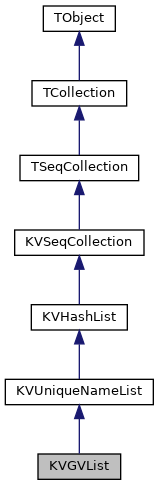
Public Member Functions | |
| KVGVList (const KVGVList &a) | |
| KVGVList (const KVString &name="default", const KVParticleCondition &selection=KVParticleCondition{"OK", [](const KVNucleus *n) { return n->IsOK();}}) | |
| bool | AbortEventAnalysis () const |
| void | Add (TObject *obj) override |
| KVEventClassifier * | AddEventClassifier (const TString &varname, const TString &value="") |
| void | AddFirst (TObject *obj) override |
| KVVarGlob * | AddGV (const Char_t *class_name, const Char_t *name) |
| KVVarGlob * | AddGVFirst (const Char_t *class_name, const Char_t *name) |
| void | CalculateGlobalVariables (KVEvent *e) |
| void | FillBranches () |
| KVVarGlob * | GetGV (const Char_t *nom) const |
| Return pointer to global variable in list with name 'nom'. More... | |
| KVVarGlob * | GetGVType (const Char_t *class_name) |
| Returns first global variable in list with given class. More... | |
| Bool_t | Has1BodyVariables () |
| returns kTRUE if list contains 1-body variables More... | |
| Bool_t | Has2BodyVariables () |
| returns kTRUE if list contains 2-body variables More... | |
| Bool_t | HasNBodyVariables () |
| returns kTRUE if list contains N-body variables More... | |
| void | Init (void) |
| void | MakeBranches (TTree *) |
| void | Reset (void) |
| Reset all variables before treating an event. More... | |
 Public Member Functions inherited from KVUniqueNameList | |
| KVUniqueNameList (Bool_t R=kFALSE) | |
| Default constructor. More... | |
| void | Add (TObject *obj) override |
| void | AddAfter (const TObject *after, TObject *obj) override |
| void | AddAt (TObject *obj, Int_t idx) override |
| void | AddBefore (const TObject *before, TObject *obj) override |
| void | AddFirst (TObject *obj) override |
| void | AddLast (TObject *obj) override |
| Bool_t | ObjectAdded () const |
| void | ReplaceObjects (Bool_t yes=kTRUE) |
| Public Member Functions inherited from KVHashList | |
| KVHashList (Int_t capacity=TCollection::kInitHashTableCapacity, Int_t rehash=2) | |
| Float_t | AverageCollisions () const |
| template<typename T > | |
| Bool_t | ContainsObjectWithName (const T &o) |
| const TList * | GetListForObject (const char *name) const |
| const TList * | GetListForObject (const TObject *obj) const |
| void | Rehash (Int_t newCapacity=0) |
| void | Sort (Bool_t order=kSortAscending) |
| Public Member Functions inherited from KVSeqCollection | |
| KVSeqCollection () | |
| KVSeqCollection (const KVSeqCollection &) | |
| KVSeqCollection (const TString &collection_classname) | |
| KVSeqCollection (KVSeqCollection &&) | |
| virtual | ~KVSeqCollection () |
| void | Add (TObject *obj) override |
| void | AddAfter (const TObject *after, TObject *obj) override |
| void | AddAt (TObject *obj, Int_t idx) override |
| void | AddBefore (const TObject *before, TObject *obj) override |
| void | AddFirst (TObject *obj) override |
| void | AddLast (TObject *obj) override |
| TObject * | After (const TObject *obj) const override |
| TObject * | At (Int_t idx) const override |
| TObject * | Before (const TObject *obj) const override |
| void | Clear (Option_t *option="") override |
| TString | CollectionClassName () const |
| void | Copy (TObject &obj) const override |
| void | Delete (Option_t *option="") override |
| void | Execute (const char *method, const char *params, Int_t *error=0) override |
| void | Execute (TMethod *method, TObjArray *params, Int_t *error=0) override |
| TObject * | FindObject (const char *name) const override |
| TObject * | FindObject (const TObject *obj) const override |
| virtual TObject * | FindObjectAny (const Char_t *att, const Char_t *keys, Bool_t contains_all=kFALSE, Bool_t case_sensitive=kTRUE) const |
| TObject * | FindObjectByClass (const Char_t *) const |
| Return (first) object in embedded list with given class. More... | |
| TObject * | FindObjectByClass (const TClass *) const |
| Return (first) object in embedded list with given class. More... | |
| virtual TObject * | FindObjectByLabel (const Char_t *) const |
| virtual TObject * | FindObjectByName (const Char_t *name) const |
| virtual TObject * | FindObjectByNumber (UInt_t num) const |
| virtual TObject * | FindObjectByTitle (const Char_t *) const |
| Will return object with given title (value of TObject::GetTitle() method). More... | |
| virtual TObject * | FindObjectByType (const Char_t *) const |
| virtual TObject * | FindObjectWithMethod (const Char_t *retvalue, const Char_t *method) const |
| virtual TObject * | FindObjectWithNameAndType (const Char_t *name, const Char_t *type) const |
| TObject * | First () const override |
| template<typename T > | |
| T * | get_object (const TString &name) const |
| TSeqCollection * | GetCollection () const |
| TObject ** | GetObjectRef (const TObject *obj) const override |
| Return reference to object. More... | |
| Int_t | GetSize () const override |
| KVSeqCollection * | GetSubListWithClass (const Char_t *class_name) const |
| KVSeqCollection * | GetSubListWithClass (const TClass *_class) const |
| KVSeqCollection * | GetSubListWithLabel (const Char_t *retvalue) const |
| KVSeqCollection * | GetSubListWithMethod (const Char_t *retvalue, const Char_t *method) const |
| KVSeqCollection * | GetSubListWithName (const Char_t *retvalue) const |
| KVSeqCollection * | GetSubListWithType (const Char_t *retvalue) const |
| template<typename ObjectType , typename ValueType > | |
| ValueType | GetSumOverCollection (std::function< ValueType(const ObjectType *)> Function) const |
| Bool_t | IsCleanup () const |
| virtual Bool_t | IsSendingModifiedSignals () const |
| Bool_t | IsSortable () const override |
| Bool_t | IsSorted () const override |
| TObject * | Last () const override |
| TIterator * | MakeIterator (Bool_t dir=kIterForward) const override |
| Make and return iterator for the list. More... | |
| virtual void | Modified () |
| Bool_t | operator! () const |
| KVSeqCollection & | operator= (const KVSeqCollection &) |
| Info("operator=","copy ass");. More... | |
| KVSeqCollection & | operator= (KVSeqCollection &&) |
| void | RecursiveRemove (TObject *obj) override |
| TObject * | Remove (TObject *obj) override |
| Remove object from list. More... | |
| virtual void | SendModifiedSignals (Bool_t yes=kTRUE) |
| virtual void | SetCleanup (Bool_t enable=kTRUE) |
| void | SetOwner (Bool_t enable=kTRUE) override |
Additional Inherited Members | |
| Static Public Member Functions inherited from KVSeqCollection | |
| static KVSeqCollection * | MakeListFromFile (TFile *file) |
| static KVSeqCollection * | MakeListFromFileWithClass (TFile *file, const Char_t *class_name) |
| static KVSeqCollection * | MakeListFromFileWithClass (TFile *file, const TClass *_class) |
| static KVSeqCollection * | MakeListFromFileWithMethod (TFile *file, const Char_t *retvalue, const Char_t *method) |
| static void | RehashCleanupList () |
| KVGVList::KVGVList | ( | const KVString & | name = "default", |
| const KVParticleCondition & | selection = KVParticleCondition{"OK", [](const KVNucleus * n) { return n->IsOK(); }} |
||
| ) |
Create a list of global variables.
If given, the KVParticleCondition will be used to select the particles to iterate over in each event in order to calculate the global variables.
By default, if no selection is defined, only particles which are "OK" (i.e. for which KVParticle::IsOK() returns true) will be iterated over - this will change in the future!
Definition at line 33 of file KVGVList.cpp.
| KVGVList::KVGVList | ( | const KVGVList & | a | ) |
Definition at line 53 of file KVGVList.cpp.
|
inline |
Definition at line 370 of file KVGVList.h.
|
override |
Overrides KVUniqueNameList::Add(TObject*) so that global variable pointers are sorted between the 3 lists used for 1-body, 2-body & N-body variables.
We also print a warning in case the user tries to add a global variable with the same name as one already in the list. In the case we retain only the first global variable, any others with the same name are ignored
Definition at line 336 of file KVGVList.cpp.
| KVEventClassifier * KVGVList::AddEventClassifier | ( | const TString & | varname, |
| const TString & | value = "" |
||
| ) |
Add an event classification object to the list, based on the named global variable (which must already be in the list).
| [in] | varname | name of global variable previously added to list |
| [in] | value | [optional] for multi-valued variables, you can specify which value to use by name, or a mathematical expression involving one or more of the available values |
Returns a pointer to the object, in order to add either cuts or bins like so:
This will class events according to:
| mtot | mtot_EC |
|---|---|
| <5 | 0 |
| [5, 9] | 1 |
| [10, 14] | 2 |
| [15, 19] | 3 |
| [20, 24] | 4 |
| [25, 29] | 5 |
| >=30 | 6 |
mtot_EC is the default name for an event classification based on mtot and will be used for the branch added to the user's analysis TTree by method MakeBranches().
This will class events according to the 2 bins with the following numbers:
| mtot | mtot_EC |
|---|---|
| [5, 9] | 0 |
| [15, 19] | 1 |
| [25, 29] | 2 |
| other | -1 |
Note that in this case, any value outside of a defined bin is unclassified.
Definition at line 612 of file KVGVList.cpp.
|
override |
Overrides KVUniqueNameList::AddFirst(TObject*) so that global variable pointers are sorted between the 3 lists used for 1-body, 2-body & N-body variables.
We also print a warning in case the user tries to add a global variable with the same name as one already in the list. In the case we retain only the first global variable, any others with the same name are ignored
Definition at line 373 of file KVGVList.cpp.
| KVVarGlob * KVGVList::AddGV | ( | const Char_t * | class_name, |
| const Char_t * | name | ||
| ) |
Add a global variable to the list.
"class_name" must be the name of a valid class inheriting from KVVarGlob, e.g. any of the default global variable classes defined as part of the standard KaliVeda package (see the Global Variables module), or the name of a user-defined class (see below).
"name" is a unique name for the new global variable object which will be created and added to the list of global variables. This name can later be used to retrieve the object (see GetGV()).
Returns pointer to new global variable object in case more than the usual default initialisation is necessary.
The user may use her own global variables, without having to add them to the main libraries. If the given class name is not known, it is assumed to be a user-defined class and we attempt to compile and load the class from the user's source code. For this to work, the user must:
$HOME/.rootrc add the following line:It is assumed that MyNewVarGlob.h and MyNewVarGlob.cpp will be found in $HOME/myVarGlobs (in this example). The constructor taking a single character string argument (name of the variable) must be defined in the class.
Definition at line 705 of file KVGVList.cpp.
| KVVarGlob * KVGVList::AddGVFirst | ( | const Char_t * | class_name, |
| const Char_t * | name | ||
| ) |
Add a global variable at the beginning of the list.
See AddGV() for details.
Definition at line 843 of file KVGVList.cpp.
| void KVGVList::CalculateGlobalVariables | ( | KVEvent * | e | ) |
This method will calculate all global variables defined in the list for the event 'e'.
This will iterate over all particles in the event which correspond to the KVParticleCondition fSelection; if none has been defined, only particles for which KVParticle::IsOK() returns true will be used.
Note that for 2-body variables, the Fill2 method will be called for each distinct pair of particles in the event, plus each pair made up of a particle and itself.
For each variable for which an event selection condition was set (see KVVarGlob::SetEventSelection()) the condition is tested as soon as the variable is calculated. If the condition is not satisfied, calculation of the other variables is abandonded and method AbortEventAnalysis() returns kTRUE.
Definition at line 206 of file KVGVList.cpp.
| void KVGVList::FillBranches | ( | ) |
Use this method ONLY if you first use MakeBranches(TTree*) in order to automatically create branches for your global variables. Call this method for each event in order to put the values of the variables in the branches ready for TTree::Fill to be called (note that TTree::Fill is not called in this method: you should do it after this).
Definition at line 516 of file KVGVList.cpp.
| KVVarGlob * KVGVList::GetGV | ( | const Char_t * | nom | ) | const |
Return pointer to global variable in list with name 'nom'.
Definition at line 319 of file KVGVList.cpp.
|
inline |
Returns first global variable in list with given class.
Definition at line 342 of file KVGVList.h.
|
inline |
returns kTRUE if list contains 1-body variables
Definition at line 350 of file KVGVList.h.
|
inline |
returns kTRUE if list contains 2-body variables
Definition at line 356 of file KVGVList.h.
|
inline |
returns kTRUE if list contains N-body variables
Definition at line 362 of file KVGVList.h.
| void KVGVList::Init | ( | void | ) |
Initialisation of all global variables in list
As this method may be called several times we ensure that variables are only initialised once
Definition at line 66 of file KVGVList.cpp.
| void KVGVList::MakeBranches | ( | TTree * | tree | ) |
Create a branch in the TTree for each global variable in the list. A leaf with the name of each global variable will be created to hold the value of the variable (result of KVVarGlob::GetValue() method). For multi-valued global variables we add a branch for each value with name
GVname.ValueName
To avoid problems with TTree::Draw, 'GVName' will be sanitized i.e. any mathematical symbols will be replaced by '_'.
Any variable for which KVVarGlob::SetMaxNumBranches() was called with argument 0 will not be added to the TTree.
Definition at line 418 of file KVGVList.cpp.
| void KVGVList::Reset | ( | void | ) |
Reset all variables before treating an event.
Definition at line 83 of file KVGVList.cpp.
 1.9.1